O2 certificate, registration and number plates
The trailer is not just the load-bearing base of a tiny house; it is the home's legal identity. Under road traffic law, a home on wheels is treated as a trailer, and to be registered, the chassis it is built on must be type-approved.
Trailers are divided into classes O1–O4 by their gross vehicle weight (maximum laden mass). O2 covers trailers with a gross vehicle weight of more than 750 kg and up to 3,500 kg. Trailers in this class must have their own braking system; the chassis, brakes, lighting and coupling components are documented during type approval.
In Turkey, the legal status of homes on wheels is tied directly to this certificate. An amendment to the Regulation on the Qualifications of Tourism Facilities, published in the Official Gazette on 18 January 2024, defines a mobile home as a vehicle with an O2-class type-approval certificate, designed to be towed by a motor vehicle, containing living space, a bed and a bathroom with toilet, and subject to the Highway Traffic Act. The details of type approval are set out in the Turkish regulation on the type approval of motor vehicles and trailers, which is aligned with EU Regulation 2018/858. Buyers outside Turkey should check how homes on wheels are classified and registered in their own country.
Documents supplied with the trailer
- Invoice and sales documents
- Type-approval certificate (O2 class), supplied with the trailer
- Certificate of conformity: shows the trailer was built to the approved type
- Chassis number (VIN) and manufacturer's plate on the chassis
- Operating and maintenance information for the axles, brakes and coupling
Registration and number plates in Turkey
- Receive the documents: When the trailer is finished, you are given the invoice, type-approval certificate and certificate of conformity.
- Register at a notary: Under current Turkish rules, the trailer is registered in your name at a notary and a number plate is assigned.
- Insurance: Compulsory motor insurance must be in place before the trailer goes on the road; once the house is finished, comprehensive cover or additional home-type insurance is worth considering.
- Transport: The trailer, or the finished house, is taken to its site by a vehicle with sufficient towing capacity or by a professional tow truck.
Please note: This section is for general information only. Registration, fees and insurance requirements can change over time; check with the notary and the relevant authorities before you apply. In other countries the procedure is different, so check the rules with your local registration authority. For more on using a home on wheels on your land, see our tiny house guide.
Specifications
Every trailer is sized for the length, frame type and estimated laden weight of the house it will carry. The table below summarises the main specifications of our standard tiny house trailer; values in italics are confirmed per project or have not yet been published.
| Vehicle class | O2 (gross vehicle weight 750–3,500 kg) |
|---|---|
| Certification | Type-approved; eligible for registration and plates |
| Gross vehicle weight | Per project, up to 3,500 kg |
| Unladen weight | Depends on length; stated in the quote |
| Standard length | 8.00 · 9.00 · 10.00 m (deck length) |
| Width | House external width 2.50 m; within the 2.55 m road limit |
| Overall height (with house) | Max. 4.00 m from the ground |
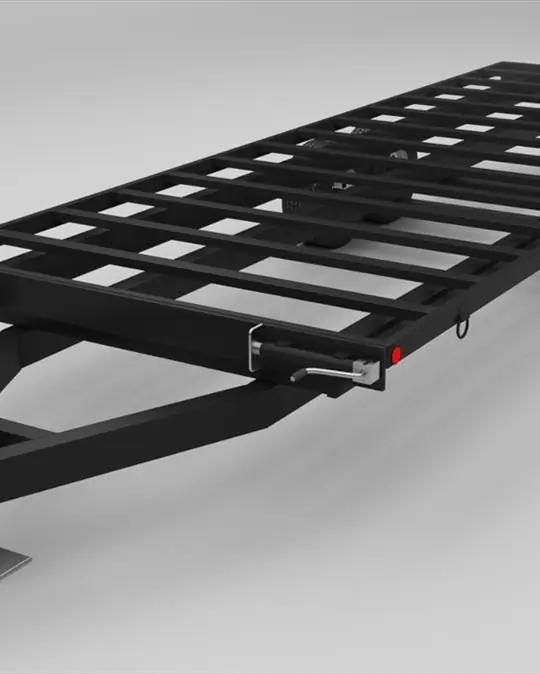
| Chassis | High-strength steel sections, cut and welded into a load-bearing frame |
| Section sizes | Determined by length and load |
| Surface protection | Galvanised; extra paint coat on request |
| Axles | Twin axle (tandem), with suspension |
| Axle capacity | Selected according to gross weight |
| Brakes | Overrun braking system operated by the braked coupling; handbrake |
| Running gear brands | KNOTT / AL-KO / ÇAYIROVA |
| Tyres and wheels | Size and load index matched to axle capacity |
| Drawbar | A-frame (V-type) drawbar with braked coupling |
| Supports | Front jockey wheel and corner steadies |
| Lighting | Brake, indicator, side/tail and number-plate lights, reflectors |
| Electrical socket | Trailer socket to suit the towing vehicle |
A trailer works best when it is designed together with the frame of the house: the points where wall, floor and loft loads transfer into the chassis are planned from the start, and the axles are positioned according to the centre of gravity of the load. In our own models, the galvanised light-steel frame is fixed directly to this chassis.
Length options
The length of the trailer determines the house's net floor area, its weight and how easily it can be moved. Our standard production covers the three lengths our tiny house models are built on. At every length, width and height stay within road limits.
Compact and agile
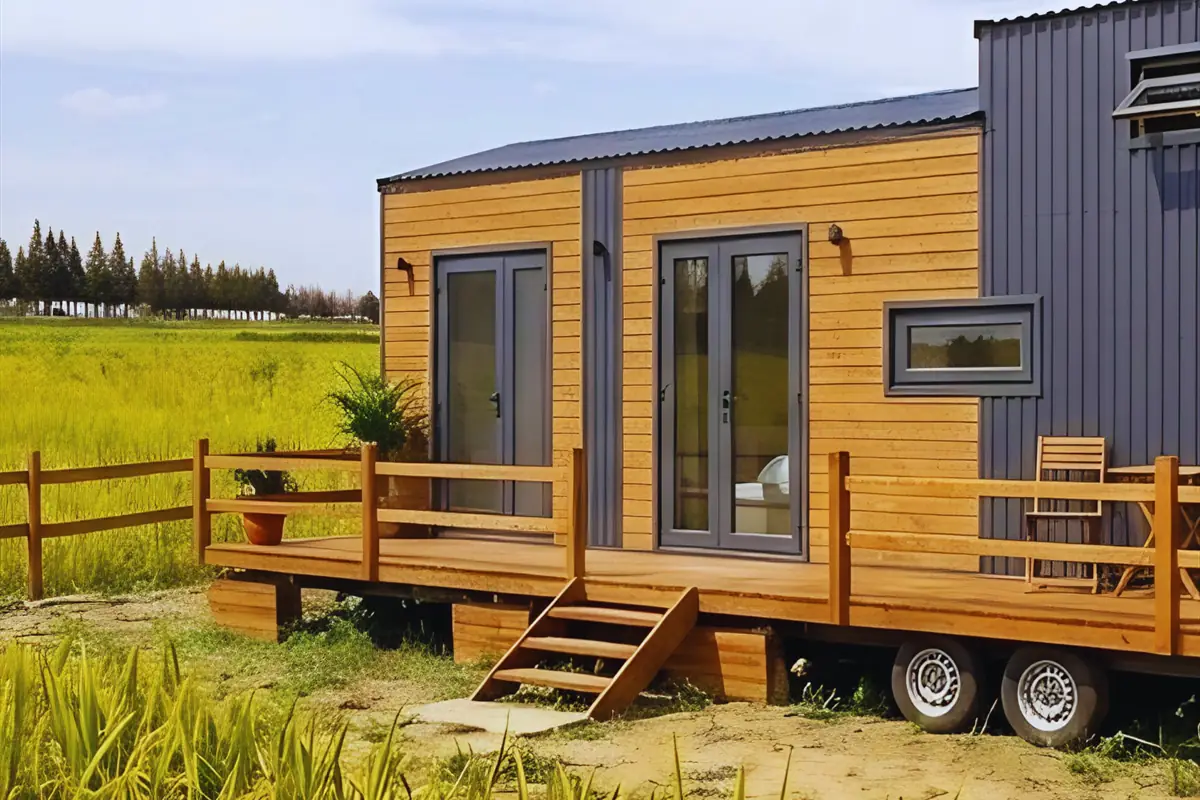
About 26 m² net floor area. The easiest to tow; suited to narrow country roads and frequent moves.
House on this chassis: BademBalanced layout
23–28 m² net floor area. Long enough for a ground-floor bedroom and a loft; the best balance of weight and space.
House on this chassis: DefneMost living space
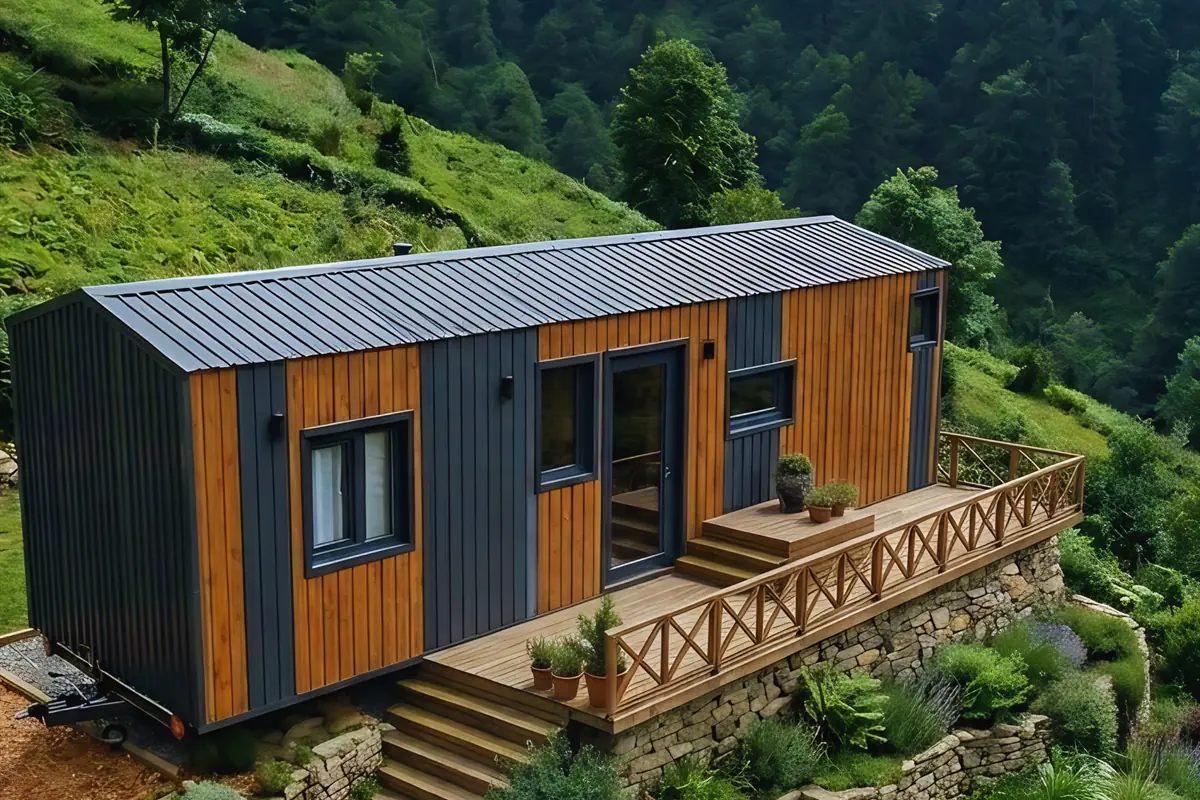
31–37 m² net floor area. Can carry a large living room, a bedroom and two lofts; the choice of towing vehicle becomes more important.
House on this chassis: MeşeOther lengths: If your project needs a chassis shorter than 8 metres or longer than 10 metres, tell us when you request a quote; the possible size range and weight limits are assessed for each project.
Axles, brakes, coupling and other running gear
How a trailer behaves on the road depends as much on its running gear as on the chassis. That is why we use only components from well-known manufacturers for the axles, brakes and coupling.
Twin axle
The load is shared between two axles, giving a more stable ride than a single axle, lower tyre loads and a steadier stance when parked.
Braking system
When the towing vehicle slows down, the overrun coupling applies the trailer's own brakes. The handbrake holds the trailer in place when parked.
Braked coupling
KNOTT, AL-KO or ÇAYIROVA components. Together with the drawbar, the coupling is the part that connects the trailer to the vehicle's tow ball and transmits the braking force.
Drawbar
The A-frame (V-type) drawbar spreads the load into the chassis at a wide angle and resists twisting when manoeuvring.
Supports
At the front, a jockey wheel carries the trailer while hitching and unhitching. On site, the house is levelled with corner steadies and blocks, taking the load off the suspension.
Lighting
Brake, indicator and side lights, number-plate light and reflectors are positioned in line with regulations; cables run protected inside the chassis.
The brand of running gear used on your trailer, and its capacities, are stated clearly in the quote.
Galvanising and paint
Unlike an ordinary goods trailer, a tiny house trailer stands in the same place for years, close to the ground, in damp and often shady conditions. That makes corrosion the chassis's biggest enemy.
- Galvanised coating: The zinc layer on the steel stops moisture and oxygen reaching the metal; even if the coating is scratched, the surrounding zinc continues to protect the steel.
- Weld points: Areas that are welded or drilled later must be touched up with cold galvanising paint. If you are building your own house, don't skip this step.
- Paint and topcoat: An extra coat of paint on visible surfaces both improves protection and matches the chassis to the facade of the house; colour options are shared at quote stage.
- Underside: Once the house is installed, air must be able to circulate under the chassis; if the base is to be fully skirted, leave ventilation openings.
Manufacturing stages
Every trailer is built for the house it will carry, in the following steps:
- Planning and design: The house's dimensions, frame type and estimated weight are determined. The chassis is designed around these figures, road traffic regulations and the weight limits of the O2 class.
- Chassis fabrication: High-strength steel sections are cut to size and welded together; angle brackets and cross members spread the floor load into the load-bearing frame.
- Surface protection: The chassis is galvanised against corrosion and the required surfaces are painted.
- Axles and suspension: The twin axles and suspension are fitted, positioned according to the centre of gravity of the load.
- Brakes, coupling and tyres: The braked coupling, drawbar, brake components and tyres rated for the trailer's capacity are fitted.
- Electrics and lighting: Brake, indicator and side lights, reflectors and the connecting socket are wired up.
- Inspection and documents: Dimensions, brakes and lighting are checked; the type-approval certificate and certificate of conformity are prepared and the trailer is delivered.
Tips for self-builders
If you buy the trailer from us and build the house yourself, most of the work starts after the chassis is delivered. The points below prevent the mistakes we see most often, and the ones hardest to put right later.
- Draw up a weight budgetCalculate the house's total weight in advance, including the frame, cladding, insulation, windows and doors, kitchen, bathroom, appliances, furniture and water tank. The laden weight must not exceed the trailer's gross vehicle weight; leave a margin.
- Distribute the weight evenlyPlace heavy items (bathroom, kitchen, water tank) over or near the axles. Weight piled at the rear makes the trailer sway; weight piled at the front overloads the coupling and the towing vehicle's rear axle.
- Include cladding in your dimension limitsThe 2.55 m width limit includes external cladding, eaves and window trims. The 4.00 m height limit is measured from the ground, including the trailer and the roof.
- Fix the frame to the chassis correctlySecure the wall frame to the chassis only at the designated fixing points and with suitable fixings. If you need additional connection plates, ask for them when you order.
- Protect the galvanisingIf you have welded or drilled the chassis, seal those points with cold galvanising paint. Do not modify the axles, brakes or coupling; doing so can invalidate the type approval.
- Protect the floor from moistureUse waterproofing and a vapour barrier between the chassis and the floor, and insulate around the wheel arches separately.
- Think about the towing vehicle earlyCheck your vehicle's braked towing capacity on its registration document, and your driving licence category. If the vehicle will not be enough once the house is finished, plan for a professional tow truck.
If you would rather have a turnkey house than a trailer, our tiny house prices page shows what is included and the available options.
Trailer maintenance and pre-tow checks
Tiny houses are usually moved not several times a year but once every few years. A trailer that has been standing for a long time must always be checked before it goes on the road.
- Tyres: Check pressures, tread depth and sidewall cracks; tyres that stand in one place for a long time age.
- Brakes: Have the brake adjustment and handbrake checked by a specialist.
- Bearings and coupling: Have the wheel bearings checked for play; lubricate the coupling's moving parts as the manufacturer recommends.
- Lights and socket: Test all lights and the connecting socket.
- Steadies and blocks: When the house is repositioned, set the steadies on firm ground, level the trailer and take the load off the suspension.